Mental health · England
Understanding CBT
Your browser or device provides the reading voice.
CBT is a kind of talking therapy.
You and a therapist work together.

Notice connections
Thoughts, feelings and actions can affect each other.
What you feel in your body matters too.

Choose your goals
Talk about what you want help with.
Agree goals that matter to you.

Work together
Your therapist should explain the plan.
Tell them if something does not make sense.

Your experiences matter
Therapy should not dismiss real problems or abuse.
You are not to blame for someone else hurting you.

Find the right therapy
Different problems may need different kinds of CBT.
Ask which treatment could help you and why.
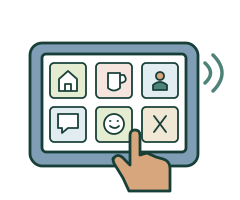
Ask for adjustments
Ask for pictures, clear words, breaks or more time.
A supporter you choose can help if you want.

Practise small steps
Agree something manageable to practise between sessions.
Tell your therapist if it is too difficult.

Check how it is going
Talk about what helps and what does not.
You can ask about changing the plan.
Urgent help
For urgent mental health help, call 111 and select the mental health option.
If you cannot keep yourself or someone else safe, call 999 or go to A&E.
What you can do next
Ask about therapy that fits your goals and support needs.
Read NHS information about CBT Web pageThis link opens another website.
It may use harder words.
More useful links
- NHS: cognitive behavioural therapy Web page
What CBT involves, assessment and ways to get treatment.
- NHS: talking therapies Web page
Self-referral for anxiety and depression and specialist referral routes.
- BABCP: what is CBT? Web page
Collaborative goals and practising skills in daily life.
- NHS: urgent mental health help Web page
Urgent advice and emergency help.
These links open other websites.
They may use harder words.
Cognitive behavioural therapy (CBT)
Understand practical talking therapy, shared goals, accessible sessions and how to ask for CBT.
Adults · England · Therapy should fit individual needs
How thoughts, feelings and actions connect
Cognitive behavioural therapy, or CBT, is a family of talking therapies. It explores how a situation, your thoughts, emotions, body sensations and actions affect one another. For example, avoiding something because of worry may bring brief relief but make it harder to try again. A therapist helps you understand your own patterns and explore useful changes.
Work towards goals that matter to you
CBT is a partnership. Agree practical goals, such as returning to an activity or managing a particular worry. Your therapist should explain the approach and check that it makes sense to you. You may look at different explanations for a thought, solve a practical problem or try an agreed activity. The tasks should connect with what you want from everyday life.
Real difficulties deserve practical help
CBT is not simply positive thinking. Realistic worries, grief, discrimination or abuse should not be dismissed as faulty thinking. Therapy can support coping while practical problems and safety are addressed. You are not responsible for someone else abusing you. Tell the therapist if an explanation feels blaming, overlooks what happened or does not fit your experience.
The approach depends on the difficulty
Ask what kind of CBT is being offered and why. For OCD, CBT usually includes exposure and response prevention, or ERP: planned, gradual practice facing fears while reducing compulsions. This needs an agreed treatment plan with an appropriately trained therapist. A general worksheet or advice to stop worrying is not a substitute for assessment and condition-specific treatment.
Getting therapy in England
Adults registered with a GP can usually self-refer to NHS Talking Therapies for anxiety and depression, including some related conditions. You do not need a diagnosis first. For difficulties such as psychosis, bipolar disorder, eating disorders or personality disorders, speak to a GP about a suitable specialist pathway. Ask about the assessment, available formats, waiting time and support while waiting.
Make therapy accessible
Having a learning disability should not automatically rule out psychological therapy. Assessment should consider suitable treatment and adaptations. Ask for plain language, pictures, extra time, repetition, breaks or a quieter setting. Sessions and practice can be adapted to your communication, sensory and learning needs. A chosen supporter can help if you want, with agreement about privacy and their role.
Practise, then review together
Practice between appointments helps connect therapy with daily life. Agree small, achievable tasks and any reminders or support you need. Tell your therapist what helped, what was difficult and whether distress increased. Review progress against your goals. CBT does not help everyone in the same way; changes to the plan, more support or a different treatment may be needed.
When help is urgent
For urgent mental health help, use NHS 111’s mental health option or an urgent GP appointment. Call 999 or go to A&E if life is at risk or someone cannot be kept safe.
Words you could use
“Please explain which therapy fits my needs, agree goals with me and make the sessions and practice accessible.”
More useful links
- NHS: cognitive behavioural therapy Web page
What CBT involves, assessment and ways to get treatment.
- NHS: talking therapies Web page
Self-referral for anxiety and depression and specialist referral routes.
- BABCP: what is CBT? Web page
Collaborative goals and practising skills in daily life.
- NHS: urgent mental health help Web page
Urgent advice and emergency help.
These links open other websites.
They may use harder words.
Where the information comes from
Links checked 9 November 2026.
These links open other websites.
They may use harder words.
- NHS: cognitive behavioural therapy Web page
Assessment, treatment formats, practice and reviewing progress.
- BABCP: what is CBT? Web page
Connections between thoughts, feelings, physical sensations and actions; shared goals.
- Royal College of Psychiatrists: CBT Web page
Realistic thinking, practical problem-solving and common misunderstandings about CBT.
- NHS: OCD treatment Web page
Condition-specific CBT with exposure and response prevention.
- NHS: talking therapies Web page
Adult self-referral eligibility and conditions needing specialist referral.
- NICE NG54: mental health and learning disabilities Web page
Individual assessment, adapted psychological therapy and support with everyday practice.
- NHS: urgent mental health help Web page
Urgent GP or NHS 111 mental health advice and emergency thresholds.