Rights & choices · England
Ask for changes that help you
Your browser or device provides the reading voice.
Services should be accessible to disabled people.
You may need changes to use a service or take part.

These changes are called reasonable adjustments.
They help reduce difficulties linked to disability.
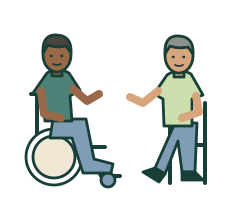
You may need a ramp, an accessible toilet or a seat.
You may need more time or a quieter place.

You may need help to understand information.
You may use signs, pictures or a communication device.
Tell staff what works for you.

Explain what is difficult for you.
Explain what would help.
You can ask someone you trust to help you ask.

Ask staff to write down the changes you need.
Ask what they have agreed to do.
Tell them if your needs change.

You should not pay extra for an adjustment the organisation must make.
Ask staff to explain if they want to charge you.

Ask staff to explain if they refuse a change.
Ask about another way to help.
You can ask an advocate for support.
What you can do next
Tell the service what would help you.
Ask for a reply in a way you understand.
Read about disability rights Web pageThis link opens another website.
It may use harder words.
More useful links
- NHS reasonable adjustment flag Web page
Ask your health team to explain how your needs are recorded.
- Rights in education Web page
Information about support in schools, colleges and universities.
- BILD: making information accessible Video
A public webinar from July 2026 about clearer information and working with people with learning disabilities. With a self-advocate and a speech and language therapist.
These links open other websites.
They may use harder words.
Access needs and reasonable adjustments
Ask services, colleges and other organisations for changes that help you take part.
England · Disabled children and adults · The detailed legal duties depend on the setting
What the duty means
The Equality Act 2010 requires reasonable steps to address substantial disadvantages experienced by disabled people where the relevant duty applies. Substantial means more than minor or trivial. Changes can involve a rule or usual practice, a physical feature, or an aid or extra assistance. The exact duties differ between services, employment, education and housing.
A service should plan ahead
Service providers should anticipate disabled people’s access needs, rather than waiting for every person to request help. Tell the organisation about your own needs as early as you can. What is reasonable depends on the circumstances, including whether the change works, practicality and resources. The organisation cannot pass on the cost of a reasonable adjustment it is legally required to make.
Describe what gets in the way
You might need step-free access, an accessible toilet, seating while waiting, a quieter space, longer appointments, breaks or information in a different format. Explain the effect of the barrier and suggest what helps. For example: several questions at once are difficult to process; please ask one question and allow time for a response. Your own experience is useful evidence.
Information and communication
Ask for the contact method and communication support you need: for example, a text reminder, simple language, a communication aid, an interpreter or help to understand a letter. Do not assume Easy Read suits everyone. Organisations providing publicly funded NHS care or adult social care must have regard to the Accessible Information Standard. It explains how they should identify, record, flag, share, meet and review disability-related information and communication needs.
Recording health access needs
Ask your GP or health team to record your reasonable adjustments and discuss the Reasonable Adjustment Digital Flag. This allows authorised staff to find important access information across health and care services. Ask what is recorded, how it is shared and how to correct it. A flag or passport is useful, but staff still need to check your current needs and put the adjustments into practice.
College and school
Education providers also have adjustment duties, including appropriate aids and support. Schools have a separate accessibility-planning duty concerning changes to buildings; the physical-feature adjustment rules are not identical to those for colleges or services. Ask the education setting’s disability or learning-support team about the arrangements you need. An education, health and care plan is not the only route to adjustments.
If the change is refused or does not work
Ask for the reasons and any suitable alternative in an accessible form. Keep a note of what was requested, the reply and the effect on you. You can use the organisation’s complaints procedure and seek advocacy or specialist discrimination advice. Court and tribunal time limits vary and can be short; a complaint does not automatically protect a legal deadline.
Words you could use
“I find this difficult because of my disability: … This change would help me: … Please tell me what you can arrange and record what we agree.”
More useful links
- NHS reasonable adjustment flag Web page
Ask your health team to explain how your needs are recorded.
- Rights in education Web page
Information about support in schools, colleges and universities.
- BILD: making information accessible Video
A public webinar from July 2026 about clearer information and working with people with learning disabilities. With a self-advocate and a speech and language therapist.
These links open other websites.
They may use harder words.
Where the information comes from
Links checked 27 October 2026.
These links open other websites.
They may use harder words.
- Equality Act 2010, section 20 Web page
The adjustment duty, its three requirements and the rule on charging for required adjustments.
- EHRC: service providers’ reasonable adjustment duties Web pageDetailed official guidance
Statutory code guidance on anticipatory adjustments, practical steps and reasonableness.
- GOV.UK: disability rights in education Web page
Education adjustments and the distinction between schools’ physical-access planning and adjustment duties.
- NHS England Digital: Reasonable Adjustment Flag Web page
Recording, sharing and using individual access information, including communication needs.
- NHS England Digital: flag standard Web page
The current standard and its scope. A record does not replace the need to provide the agreed support.
- NHS England: Accessible Information Standard Web page
The scope of the standard and support for disability-related information and communication needs.
- BILD: making information accessible Web page
A public webinar from July 2026 about clearer information and working with people with learning disabilities. With a self-advocate and a speech and language therapist.