Money & rights · England
Getting ready for a benefits appeal
Your browser or device provides the reading voice.
A tribunal can look at some benefits decisions.
It is separate from the office that made the decision.

Check the appeal steps
You usually need to ask the benefit office to look again first.
Keep the reply and check the appeal deadline.

Do not wait too long
Ask for help as soon as possible.
Tell the tribunal if your appeal is late.
Explain why.
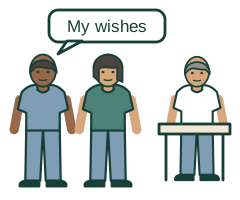
Choose your support
You can ask an adviser for help.
Tell the tribunal who is helping you.

Read the papers
You will receive papers about the decision.
Ask for help to understand them.
Write down what you disagree with.

Gather examples
Explain what happens in your daily life.
Send useful evidence before the hearing.

Ask for adjustments
Tell the tribunal how you communicate.
Ask for breaks or other help you need.

At the hearing
People will ask questions about your circumstances.
Ask them to repeat or explain a question.
Say if you need a break.
After the hearing
Keep the decision.
Ask someone to explain it.
Get advice quickly if you think it is wrong.
What you can do next
You can use the worksheet to prepare.
Ask someone you choose to help if you want.
Read the official benefits appeal steps Web pageThis link opens another website.
It may use harder words.
More useful links
- GOV.UK: appeal a benefit decision Web page
Official steps, forms and sources of advice.
- GOV.UK: what happens at the hearing Web page
Participation, adjustments and expenses.
These links open other websites.
They may use harder words.
Preparing for a benefits tribunal — Easy Read
Prepare evidence, ask for adjustments, understand the hearing and follow up the decision.
England · Money, rights and support
Check the correct route
This guide concerns Social Security and Child Support Tribunal benefit appeals in England. Usually you need a mandatory reconsideration decision first. Your appeal normally must reach the tribunal within one month after the mandatory reconsideration notice was sent to you. Follow your notice: some decisions use a different route. Explain delay if late and get advice promptly; acceptance is not guaranteed. An appeal is free.
Submit the appeal
Use the official online service or the appropriate paper form linked from GOV.UK. Say which findings are wrong and why. Keep the acknowledgment and reference, and check that the appeal was received. You do not need every possible report before starting, but follow directions about evidence. Tell HMCTS if you need a non-digital route.
Adviser, representative or supporter
A welfare rights adviser may help prepare the case or represent you. Availability varies. Register a representative with the tribunal as soon as possible. A trusted supporter may help you stay calm or communicate, but is not automatically your legal representative. Tell the tribunal what role each person will have. If no representative is available, you can still appeal and ask for access support.
Use the evidence bundle
Read the benefit office’s response and the papers with someone you choose. Note page numbers, factual mistakes and missing evidence. Prepare a short list of disputed points and real examples. Evidence should help explain your circumstances at the time of the decision being challenged; tell an adviser about later changes, which may need separate reporting. Avoid sending a large collection without explaining why it matters.
Send useful evidence
Care plans, professional reports and statements from people who know your support needs may help. Explain what assistance is needed, how often and what happens without it. Keep copies and use the appeal reference. Submit evidence by the route and date in the tribunal’s instructions. Evidence is normally shared with the other parties: ask HMCTS for advice before sending unusually sensitive material.
Arrange an accessible hearing
Explain needs when appealing and follow up before the hearing. You can request communication support, accessible documents, extra processing time, breaks and an accessible venue. Tell HMCTS about any barrier to phone or video participation and discuss the format. Check what has been agreed. Arrange an interpreter through the tribunal rather than assuming you can bring your own.
Prepare for the day
Check the time, address or joining instructions. Have the papers and your main points ready. For remote hearings, plan a private place, usable device and connection. If you cannot attend or join, contact the tribunal immediately, explain why and ask for directions. Do not assume the hearing has been postponed. Ask the clerk about eligible expenses and keep receipts.
Answer at your own pace
The panel is independent of the benefit office. It asks about your condition and circumstances. Explain your experience honestly, including difficult and better days. Say when you do not understand; you can ask for a question to be rephrased or for a break. The department may attend, but it does not decide the appeal.
Read and follow up the result
Keep the decision and ask the benefit office about implementation and any arrears if you win. If you think the tribunal made an error, obtain specialist advice promptly. A procedural problem may support a set-aside request; an Upper Tribunal appeal concerns an error of law. The usual first step for that appeal is making sure your request for written reasons reaches the tribunal within one month after it sent or otherwise provided the decision notice. Follow the notice and further time limits.
Words you could use
“For my benefit appeal I need these adjustments: … Please confirm the hearing arrangements and how my supporter can help me participate.”
More useful links
- GOV.UK: appeal a benefit decision Web page
Official steps, forms and sources of advice.
- GOV.UK: what happens at the hearing Web page
Participation, adjustments and expenses.
These links open other websites.
They may use harder words.
Where the information comes from
Links checked 7 November 2026.
These links open other websites.
They may use harder words.
- GOV.UK: benefits appeals Web page
Routes, fees and the usual appeal deadline.
- GOV.UK: submit an appeal Web page
Online and paper submission and help.
- GOV.UK: after submission Web page
Departmental response, evidence and managing the case.
- GOV.UK: at the hearing Web page
Participation, adjustments, panel and expenses.
- GOV.UK: challenging the tribunal decision Web page
Written reasons, set aside and permission to appeal.
- Upper Tribunal: IC v SSWP [2025] UKUT 223 (AAC) PDF
The relevant time is when the circumstances existed, not when the evidence was written. PDF; legal language.
- Tribunal procedure rule 22 Web page
The appeal deadline runs from the sending of the mandatory reconsideration notice.
- Tribunal procedure rule 34 Web page
Time limit for receipt of a request for written reasons.
A page for you to fill in
You can type your answers and download a copy.
You can also print a page to write or draw on.
Someone you trust can help you.