Communication & senses · England
Sharing time without needing words
Your browser or device provides the reading voice.
You can communicate in different ways.
Intensive Interaction is one way people can share time and communicate.
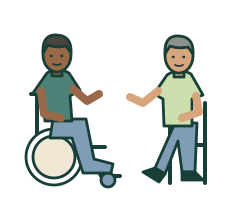
You do not have to speak.
You might use sounds, movements or your face.
Other people should notice how you communicate.
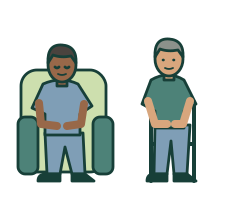
Someone spends time with you.
They notice what interests you.
They follow your lead.
They might gently answer a sound you make.
They wait to see what you do next.
There is no need to rush.

You do not have to look into someone's eyes.
You do not have to be touched.
People should respect what feels comfortable for you.
You can have a break or stop.
You might show this without using words.
People should notice and respect this.

You can still use your other ways of communicating.
This could include signs, pictures or a communication device.
A communication device helps you share a message.

Ask for help to find what works for you.
A speech and language therapist helps people with communication.
People who support you can learn with you.
What you can do next
Ask your support team about Intensive Interaction.
Ask how it could work with your other communication support.
Read about Intensive Interaction Web pageThis link opens another website.
It may use harder words.
More useful links
- Intensive Interaction training Web page
Some courses cost money. Check the details before booking.
These links open other websites.
They may use harder words.
Intensive Interaction: connecting and communicating
An introduction to person-led interaction for people, families and supporters.
Children and adults · Information for people and supporters in England
What the approach is for
Intensive Interaction centres on an enjoyable relationship and a two-way exchange. The supporter changes how they communicate to make connection easier. It may be useful for children and adults with profound or severe learning disabilities, autistic people and others with complex communication needs. A diagnosis alone does not tell you whether it is right for someone. Adults should be approached as adults, with respect for their identity and preferences.
Communication includes much more than speech
The approach supports foundations of communication, such as sharing attention, noticing another person, exchanging sounds or expressions, taking turns and enjoying company. It does not require the person to speak. Someone might communicate through a small movement, a change of expression or a sound. The supporter needs to notice what is possible and comfortable for that individual. There is no promise that the approach will lead to speech or any particular outcome.
Observe, wait and respond
Begin by watching and listening without rushing to organise an activity. Find a comfortable position and distance. Let the person's current interests and actions guide the exchange. A supporter might gently respond to a sound or movement, then leave a generous pause. Notice the response before doing more. This is a responsive relationship, not a requirement to copy every action mechanically or make the person perform a task.
A simple example
For example, a person makes a quiet humming sound while relaxed. A familiar supporter might softly echo it once, then wait. The person may answer, pause, move away or do something different. The supporter responds to what happens rather than repeatedly prompting another hum. This is only an illustration: use knowledge of the person's hearing, comfort, preferences and communication, with guidance where needed.
Respect comfort, choice and stopping
Never force eye contact, touch, closeness or speech. These are not tests the person must pass. Watch for their individual signs of welcome, uncertainty, tiredness or wanting to stop. Pause or stop if the person disengages or seems uncomfortable, and reconsider the approach. Do not treat an unfamiliar or reduced response as a reason to increase stimulation. New distress or a change in usual responses may need a health check rather than more interaction.
Keep other ways of communicating available
Intensive Interaction can be one part of a wider communication plan. It should not replace assessment by a speech and language therapist, healthcare assessment, or communication aids the person uses. Augmentative and alternative communication, often called AAC, includes ways to support or replace speech, such as signs, objects, communication boards and devices. Ask the therapist how different approaches can work together for this person.
Learn and review together
Ask an experienced practitioner or the speech and language therapy team for guidance. Record what the person did, what the supporter did and what seemed comfortable or enjoyable. Keep observations separate from guesses about meaning. Share useful information with the person's agreed support team. The Intensive Interaction Institute does not endorse scoring people through a fixed hierarchy of stages or levels. Its website provides an introduction, resources and training information.
Words you could use
“Please help us understand this person's communication and whether Intensive Interaction could be useful alongside their other support.”
More useful links
- Intensive Interaction training Web page
Some courses cost money. Check the details before booking.
These links open other websites.
They may use harder words.
Where the information comes from
Links checked 27 October 2026.
These links open other websites.
They may use harder words.
- Intensive Interaction Institute: the approach Web page
The Institute explains the approach and foundations of communication, and cautions against fixed stages or levels.
- Graham Firth: Intensive Interaction questions Web page
A specialist practitioner's explanation of who may use the approach and how supporters can respond.
- Graham Firth: practical principles Web page
Guidance on following the person's lead, pacing, enjoyment and asking for support.
- York and Scarborough NHS: using Intensive Interaction (PDF) Web page
Children's speech and language therapy advice, including following the child's lead and stopping when they want to stop.
- Royal College of Speech and Language Therapists: AAC Web page
Information for people and families about communication methods, aids and individual speech and language therapy support.
- Intensive Interaction Institute: introductory training Web page
Current information about introductory training. Some courses and resources have a charge.