Advocacy · England
Help when care limits your freedom
Your browser or device provides the reading voice.
This guide explains support to understand and question restrictions on your freedom.
Different rules apply in different places.

Some adults in hospitals or care homes have a DoLS authorisation.
DoLS means Deprivation of Liberty Safeguards.
An authorisation is legal permission for particular care arrangements.
Ask the council what your authorisation allows.

A standard DoLS authorisation gives you a right to a representative.
A representative is someone who supports you to use your rights.

Your representative might be a suitable family member or friend.
Or the council may arrange a paid representative.
The council chooses someone who meets the rules.

Your representative should keep in contact with you.
They should help you understand the authorisation.
They should help you question it when needed.

You or your representative can ask for the authorisation to be reviewed.
A review means checking the decision again.
You can also get help to ask the court to look at it.
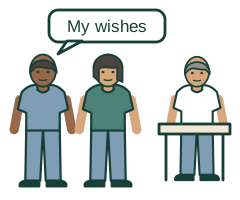
You may also get help from an independent mental capacity advocate.
This is someone independent who helps you use your rights.
Ask the council about this, especially if your representative is unpaid.

Court of Protection cases have their own rules about representation.
The court must consider how you will take part.
It can appoint someone to explain your wishes and feelings.

The law about deprivation of liberty changed in June 2026.
Ask which legal rules apply to your care arrangements.
Ask who is helping you understand and use your rights.
You can ask a solicitor for advice about your situation.
A solicitor gives legal advice.

Care at home or in supported living
Different court rules apply to restrictions at home or in supported living.
Read our community DoLS guide to find out more.
What you can do next
Ask for the team that deals with DoLS.
Ask how to contact your representative.
Find your council Web pageFuller informationThis link opens another website.
It may use harder words.
Representation when liberty is restricted
Understanding RPRs, DoLS advocacy and Court of Protection representatives.
DoLS for adults aged 18+ and separate court representation · England
The relevant person's representative — RPR
After a standard Deprivation of Liberty Safeguards authorisation is granted, the council must appoint an RPR as soon as practicable. This may be an eligible family member or friend, or a paid representative. The RPR maintains contact and supports your rights, including review and court challenge where appropriate.
Extra IMCA support under section 39D
Where a standard authorisation is in force and the RPR is unpaid, you or the RPR can ask the council for an IMCA. The council must also act in certain situations where rights would otherwise go unexercised. This support helps with understanding, requesting review and applying to court, subject to the statutory exceptions.
Sections 39A and 39C are different
Section 39A concerns IMCA support at specified DoLS stages when no appropriate unpaid person is available to consult. Section 39C provides interim IMCA support in qualifying cases after an RPR's appointment ends. A paid RPR is not simply another name for a section 39D IMCA.
Court of Protection participation
The court must consider how the person at the centre of the case will take part. A Rule 1.2 representative may be appointed to convey their wishes and feelings. An accredited legal representative or a litigation friend has a different role. The court decides the suitable arrangement; relatives are not automatically appointed.
Get the right route checked
DoLS is the hospital and care-home scheme for adults. Other settings and court proceedings need the correct legal route. Ask the council's DoLS team or a specialist solicitor about the particular authorisation or order. This guide explains representation, not the legal test for whether an arrangement deprives someone of liberty.
Current guidance on deprivation of liberty
The legal approach to identifying deprivation of liberty changed in June 2026. Ask the council or a specialist solicitor to check your circumstances against the current guidance. Compliance alone does not establish consent, and safeguards still apply where required. The change does not automatically cancel an existing authorisation.
Words you could use
“Who is my representative, and how can I get support to understand or challenge this authorisation or court order?”
Where the information comes from
Links checked 26 October 2026.
These links open other websites.
They may use harder words.
- Mental Capacity Act 2005, Schedule A1 Web page
Part 10 concerns relevant person's representatives.
- Mental Capacity Act 2005, section 39D Web page
IMCA support where the representative is unpaid.
- Mental Capacity Act 2005, section 39A Web page
IMCA representation at specified DoLS stages.
- Mental Capacity Act 2005, section 39C Web page
Interim IMCA support after a representative's appointment ends.
- Court of Protection Rules 2017 Web page
Rule 1.2 and Part 17 distinguish participation and representation arrangements.
- DHSC: deprivation-of-liberty guidance, September 2026 Web page
New source checked 27 October 2026: the changed legal approach and continuing safeguards.