Rights & choices · England
Getting help with an important decision
Your browser or device provides the reading voice.
This guide is for people aged 16 and over in England.
You should have support to make your own decisions.

Capacity means being able to make a particular decision.
You might manage one decision and need help with another.

Ask for information in a way you understand.
You can communicate without speaking.

The right time and place can help.
Tell people if pain or tiredness makes deciding harder.

An assessment checks whether you can make this decision now.
A choice other people dislike does not prove you cannot decide.

If someone must decide for you, your wishes still matter.
They must follow the law and consider your best interests.

Ask who is making the decision and why.
Ask for a record you can understand.

Nobody can agree to sex or marriage for you.
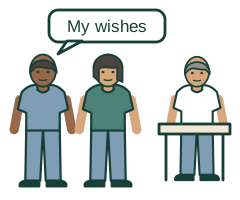
Ask for an advocate if you need help.
A specialist solicitor can advise about a serious disagreement.
What you can do next
The NHS guide explains capacity and best interests.
Ask someone you choose to help you read it.
Read the NHS guide Web pageFuller informationThis link opens another website.
It may use harder words.
More useful links
- NHS: the Mental Capacity Act Web pageFuller information
An introduction to supported decisions, capacity and best interests.
- Court of Protection: a welfare decision Web page
Information about asking the court to decide a particular welfare matter.
These links open other websites.
They may use harder words.
Capacity assessments and best-interests decisions
Understand assessments, prepare for decisions and challenge concerns about how a decision was made.
People aged 16 and over · England
Start with support
The Mental Capacity Act generally applies from age 16. A learning disability does not by itself show that someone cannot decide. Explain the actual choice using suitable words, objects, pictures or communication aids. Consider pain, tiredness, anxiety, sensory needs and whether a better time or setting would help.
What an assessment checks
The assessment concerns this decision now. It asks whether an impairment or disturbance of the mind or brain causes difficulty that prevents the person making it. Relevant abilities are understanding information, retaining it long enough, using or weighing it, and communicating a decision by any means. An unwise choice alone does not establish incapacity.
Ask for clear evidence
Ask which decision is being assessed, what information matters and what support was tried. Request an accessible explanation of the conclusion. For someone with profound and multiple learning disabilities, involve people who understand their communication and consider specialist input. Do not confuse absence of speech with absence of understanding. Review the assessment when circumstances change.
When another decision is necessary
If the person lacks capacity for this decision, identify who has lawful authority to act. Best interests include the person’s past and present wishes, feelings, beliefs and values. Help them participate. Consult relevant people and compare realistic options, including less restrictive ways to meet the purpose. A family vote does not replace this process.
Prepare for the discussion
Ask for the options, risks, benefits and decision-maker’s name before a meeting. Bring a communication profile and examples of what matters to the person. Request a written record explaining the decision and any disagreement. Ask whether an independent mental capacity advocate must be appointed; this depends on the decision and circumstances.
Limits and disagreements
Nobody can consent to sex or marriage for another person under this Act. Other decisions also have specific legal limits. If you disagree with an assessment or decision, ask for its reasons, a review and advocacy. Seek specialist legal advice promptly about serious or urgent disputes; the Court of Protection can decide relevant capacity and welfare questions. A complaint does not automatically stop a decision.
Words you could use
“Please explain the exact decision, the support offered, your assessment and how my wishes were considered. I would like to discuss a review.”
More useful links
- NHS: the Mental Capacity Act Web pageFuller information
An introduction to supported decisions, capacity and best interests.
- Court of Protection: a welfare decision Web page
Information about asking the court to decide a particular welfare matter.
These links open other websites.
They may use harder words.
Where the information comes from
Links checked 27 October 2026.
These links open other websites.
They may use harder words.
- NHS: Mental Capacity Act Web pageFuller information
Capacity, support and best-interests principles.
- Mental Capacity Act Code of Practice Web page
Practical assessment, consultation, excluded decisions and disputes.
- NICE NG108: decision-making and mental capacity Web page
Supporting participation and assessing specific decisions.
- Court of Protection: personal welfare decisions Web page
The route for particular welfare decisions and urgent applications.