Rights & choices · England
My choices and freedom
Your browser or device provides the reading voice.
This guide is about support that respects your rights.
You can read it with someone you trust.

Your choices matter
You should have support to make your own decisions.
A learning disability does not mean you cannot decide.

What is a restriction?
A restriction stops you doing something.
A locked door or a ban on visitors can be a restriction.

Ask why
Ask why a restriction is being used.
Ask who made the decision.
Ask for words or pictures you understand.

Look for other ways
Ask what other support could help.
Could this give you more freedom?
Support should consider your needs and safety.

Check what is wrong
Tell someone if you are in pain, frightened or upset.
Your health, communication and surroundings may need attention.
Decisions need care
Disagreeing with someone does not mean you cannot decide.
If you cannot make a decision, legal safeguards still apply.

Review restrictions
Ask when the restriction will be checked again.
Ask what could help reduce or end it.
Tell supporters how it makes you feel.
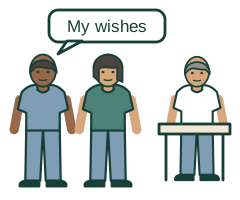
Get help to speak up
An advocate can help you explain what you want.
You can ask for advice if you disagree.

If someone is hurting you
Tell someone you trust.
Ask for safeguarding help from your council.
Call 999 if there is immediate serious danger.
What you can do next
Ask for support that gives you more choice.
Ask someone to help you question a restriction.
Read about decisions and your rights Web pageFuller informationThis link opens another website.
It may use harder words.
More useful links
- NHS: Mental Capacity Act Web pageFuller information
Support to decide, best interests and less restrictive options.
- Mental Health Act Code of Practice Web page
Includes an Easy Read version explaining rights and principles.
- DHSC: reducing restrictive interventions Web page
Adult care guidance, with an Easy Read version.
These links open other websites.
They may use harder words.
Least restrictive support: choice, safety and freedom
Understand least restrictive principles, question restrictions and ask for support that protects your rights and choices.
Adults · England · General information
What least restrictive means
A restriction limits what someone can do. Least restrictive support means considering ways to meet an identified need or safety aim while interfering as little as possible with rights and freedom. Ask whether action is needed at all and compare realistic alternatives. This does not mean ignoring serious risks. The Mental Health Act Code also promotes independence and avoiding detention where safe, lawful care can be provided without it.
Notice restrictions in everyday life
Restrictions may include locked doors, being held, limits on visits or phones, preventing access to possessions, restrictive equipment or medication used to control behaviour. What a measure means legally depends on its purpose and effect. A blanket rule applies to everyone without considering individual circumstances. Rules must not exist simply for staff convenience, punishment or because someone has a learning disability. Ask for each restriction to be identified and justified.
Support decisions and consent
Start by assuming the person can make the decision. Give accessible information, communication support and time. An unwise choice does not by itself show lack of capacity. Capacity concerns must address this decision at this time. When acting for someone who lacks capacity under the Mental Capacity Act, consider their best interests and whether the purpose can be achieved equally effectively with less restriction. Involve the person and consider their wishes.
Check the actual legal authority
A risk assessment, care-plan signature or relative's agreement does not by itself authorise restraint. Under the Mental Capacity Act, restraint requires a reasonable belief that it is necessary to prevent harm to the person, and proportionate to the likelihood and seriousness of that harm. Other legal requirements also apply. This is not a general power to restrain someone to protect other people. Different laws have different powers and safeguards; ask which applies.
Try support that removes the need for restriction
Check for pain, illness, communication barriers, fear, sensory overload and unsuitable demands. Consider changes to the environment, routines, activities, staff support and access to help. Agree goals with the person. For example, accessible travel teaching and chosen support may enable an outing. Whether an alternative is suitable depends on the person and actual risks. A behaviour support plan should include ways to reduce restrictions and improve everyday life.
Review every restrictive response
Restrictive interventions should be a last resort, with safeguards appropriate to the circumstances. Record what happened and why, check wellbeing and listen to the person's account. Review whether the intervention was needed and how to avoid it in future. Plans should name who is responsible, when reviews happen and how restrictions will be reduced or ended. Changes in health or increasing distress require earlier review. Do not change prescribed medication without clinical advice.
Extra safeguards when freedom is removed
Some care arrangements amount to a deprivation of liberty. They need specific lawful authorisation; a best-interests meeting alone is not enough. The route depends on the setting and legal circumstances. Ask what authorisation exists, its conditions, review date and how to challenge it. The linked guides explain care-home, hospital and community safeguards. A restriction being written down does not prove it is lawful.
Ask for change or independent help
Ask for an accessible explanation of the reason, alternatives, legal basis and review arrangements. Say what you disagree with and what would help. An advocate can support your voice; ask which advocacy service applies. Seek specialist legal advice about serious disputes. Raise suspected abuse or unlawful restraint with the council's adult safeguarding team. You can tell CQC about concerns in regulated care. Call 999 if there is immediate serious danger.
Words you could use
“Please explain this restriction, the alternatives and who authorised it. How can I have more choice and freedom?”
More useful links
- NHS: Mental Capacity Act Web pageFuller information
Support to decide, best interests and less restrictive options.
- Mental Health Act Code of Practice Web page
Includes an Easy Read version explaining rights and principles.
- DHSC: reducing restrictive interventions Web page
Adult care guidance, with an Easy Read version.
These links open other websites.
They may use harder words.
Where the information comes from
Links checked 9 November 2026.
These links open other websites.
They may use harder words.
- Mental Capacity Act 2005, section 1 Web page
Presumption of capacity, supported decisions, best interests and the less restrictive principle.
- Mental Capacity Act 2005, section 6 Web page
Necessary and proportionate restraint to prevent harm to the person; this is subject to the Act's other requirements.
- Mental Capacity Act Code of Practice Web page
Decision-making and limits on restraint; read with current legislation and deprivation-of-liberty safeguards.
- Mental Health Act Code of Practice Web page
Least restrictive care, independence, participation and safeguards for restrictions.
- CQC Regulation 13: safeguarding Web page
Lawful authority, proportionate restraint, protection from abuse and action on concerns.
- CQC: restraint policy Web page
Assessment, legal safeguards, staff responsibilities, monitoring and review.
- NICE NG11: recommendations Web pageProfessional guidance
Understanding needs, behaviour support, alternatives and restrictive intervention reduction.
- NICE QS101: review of restrictive interventions Web page
A documented review whenever a restrictive intervention is used.
- DHSC: Positive and Proactive Care Web page
Reducing restrictions and improving quality of life in adult health and social care.