Work & volunteering · England
Joining a trade union
Your browser or device provides the reading voice.
A trade union supports its members at work.
You can ask about joining a union.

A union may help with pay, safety and problems at work.
A union representative is often called a rep.

You can choose whether to join a union.
Your employer does not have to recognise it for you to join.

Ask which union covers your kind of job.
Tell the union what support you need.

Membership usually costs money.
Ask how much and how often you must pay.
Ask about cheaper membership if your income is low.

Ask what membership includes.
Ask whether there are rules about getting advice or legal help.

Tell the union if your problem has already started.
It might not help with every earlier problem.
Ask before assuming it will take your case.
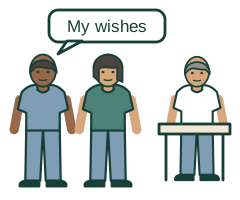
You can usually bring a suitable companion to a formal grievance meeting.
This might be a work colleague or an eligible union representative.
Ask which rules apply to your meeting.
Ask for help to understand the meeting.
You may need extra time, breaks or communication support.

Tell your representative what you want to happen.
Agree what they will do and when they will contact you.
Get advice quickly if you have a serious work problem.
Waiting for union help does not stop legal time limits.
What you can do next
Ask which union covers your work.
Check the cost and support before joining.
Read about joining a union Web pageThis link opens another website.
It may use harder words.
More useful links
- GOV.UK: joining a trade union Web page
Membership, fees, union representatives and finding a suitable union.
- TUC: find a union Web page
Find unions that may cover your work. Check their eligibility and membership conditions.
- TUC: how a union can help Web page
Support where a union is or is not recognised, and limits concerning existing problems.
- Acas: companions at grievance meetings Web page
Who can accompany you and adjustments for disability-related support.
These links open other websites.
They may use harder words.
Trade unions: joining, getting advice and support at meetings
Find a suitable union, understand membership and ask what support is available with workplace problems.
Employees and workers · England
What a union can do
A trade union brings workers together to improve working life. It may advise on pay, safety, discrimination, adjustments and workplace problems. Representatives can help members prepare for meetings and raise concerns. Where a union is recognised, it can negotiate collectively with the employer about matters such as pay and conditions. Individual support and collective bargaining are different roles.
Find a union that fits your work
Ask whether there is a union representative at your workplace and which jobs their union covers. You can also use the TUC union finder or the official trade-union list linked from GOV.UK. Explain your job, employer, employment status and any accessibility needs. Check membership eligibility before paying; some unions cover particular occupations or sectors.
Check costs and membership terms
Ask for the subscription amount, reduced-rate options, how to pay and how to cancel. Fees can depend on income or circumstances. Ask what advice, representation and legal help are included and whether waiting periods or other conditions apply. Payment through wages requires your written permission. Keep your membership details and the contact route for support.
Recognition is not permission to join
You can choose to join or not join a union, including one the employer does not recognise. Recognition concerns collective negotiation; it does not give the employer a veto over membership. The law protects against specified treatment because of union membership or non-membership. If you think membership has led to threats, dismissal or disadvantage, contact the union or Acas promptly.
If a problem has already started
Tell the union what has happened and when before assuming it will take the case. Some unions limit help with problems that began before membership. Legal representation can also depend on the union’s rules and its assessment of the case. Ask for a clear answer about what it can do and when. Do not allow another deadline to pass while waiting.
A companion at a formal hearing
Employees and workers can reasonably request an eligible companion at qualifying disciplinary or grievance hearings. For a grievance, the statutory right concerns an employer’s legal or contractual duty. An eligible companion is a fellow worker, an employed union official or a union official certified for this role. The employer need not recognise the union. Check that the person is available and willing to attend.
Agree practical and accessible support
Tell the employer your companion’s name and role in good time. The companion can help present your case, respond to points and confer with you. If unavailable, the law provides for postponement to a reasonable alternative within five working days of the original hearing date. Ask about disability adjustments too: additional support from a carer or another person may need consideration. These rights do not automatically apply to every informal meeting.
Keep your voice in the process
Agree what you want the representative to help with and the outcome you seek. Share relevant records and explain how you communicate. Ask them to explain advice, risks and next steps in a way you understand. If support is not working, raise it with the union and ask about its complaints or review process. Ask the union to explain any proposed settlement before deciding whether to accept it.
Words you could use
“I am thinking about joining. Do you cover my role, what does membership cost, and can you help with a problem that has already started? I need this communication support: …”
More useful links
- GOV.UK: joining a trade union Web page
Membership, fees, union representatives and finding a suitable union.
- TUC: find a union Web page
Find unions that may cover your work. Check their eligibility and membership conditions.
- TUC: how a union can help Web page
Support where a union is or is not recognised, and limits concerning existing problems.
- Acas: companions at grievance meetings Web page
Who can accompany you and adjustments for disability-related support.
These links open other websites.
They may use harder words.
Where the information comes from
Links checked 1 November 2026.
These links open other websites.
They may use harder words.
- GOV.UK: joining a trade union Web page
Union roles, recognition, membership subscriptions and payment consent.
- GOV.UK: trade-union membership rights Web page
Choosing membership and protection from specified adverse treatment.
- TUC: how can a union help? Web page
Individual advice, representation and checking help with pre-existing problems.
- Employment Relations Act 1999, section 10 Web page
Eligible companions, their role and postponement where the chosen companion cannot attend.
- Acas: the grievance meeting Web page
The scope of accompaniment and considering disability-related additional support.
- Acas: contact Web page
Employment-rights advice and conciliation contact routes.