Work & volunteering · England
Complaining about a problem at work
Your browser or device provides the reading voice.
A formal complaint to your employer is called a grievance.
You can ask for help to explain your concern.

You may try talking about the problem first.
You can make a formal complaint if this is unsuitable or does not help.

Ask for your employer’s grievance procedure.
It explains who to contact and what happens next.
Ask for information you understand.

Write down what happened and when.
Say who was involved.
Keep useful messages or documents.

Explain how the problem affects you.
Say what you want your employer to put right.

Ask for support with the process.
You may need extra time, breaks or clear written information.
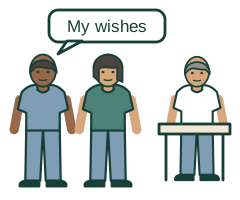
Ask whether you can bring a companion to the meeting.
This can often be a colleague or eligible union representative.
Ask about other support needed because of disability.
At the meeting, explain your main points.
Ask questions if you do not understand.
Ask for the meeting notes.

Ask for the decision and reasons in writing.
You can appeal if you disagree.
An appeal asks your employer to look at the decision again.
Check the deadline for your appeal.
There are separate deadlines for employment tribunal claims.
Making a grievance does not stop those deadlines.
Ask Acas, your union or an employment adviser for help quickly.
Do not wait for the complaint to finish before checking legal deadlines.
What you can do next
Use the blank page to organise your concern.
Ask for an accessible process and a response date.
Get help to check any legal deadline.
Read the Acas grievance guide Web pageThis link opens another website.
It may use harder words.
More useful links
- Acas: formal grievance procedure Web page
The stages from raising a concern to the outcome.
- Acas: grievance letter template Web page
A free template to adapt to your own concern.
- Acas: appealing an outcome Web page
Explaining why you disagree and what you want reconsidered.
- Acas: employment tribunal time limits Web page
Current rules, the October 2026 change and early conciliation.
- Contact Acas Web page
Ask about workplace rights and routes for help.
These links open other websites.
They may use harder words.
Making a grievance about a problem at work
Prepare a clear complaint, ask for an accessible process and understand meetings, outcomes, appeals and legal deadlines.
Employees and workers · England
Choose the right route
A grievance raises a workplace problem with your employer. You may try an informal discussion if suitable, but can use the formal route where that has failed, you do not want informal handling or the matter is serious. The Acas Code mainly applies to employees; workers should also ask what procedure they can use. Volunteering complaints may follow a different process.
Find the procedure and the right person
Ask for the written grievance policy in a format you understand. Check who should receive the complaint, stages and appeal rules. If the usual manager is involved in the concern, use the alternative contact named in the policy or ask HR or another appropriate manager. Ask a union representative or adviser for help if you are unsure.
Put the concern clearly in writing
Say that you are raising a formal grievance. Give dates, what happened, who was involved and the effect on your work or wellbeing. Identify relevant documents and people who may have useful information. Distinguish facts from what you believe happened. If you think discrimination or missing adjustments are involved, explain why. You do not need to quote legal sections to describe your concern.
Explain what you want changed
Ask for practical outcomes: for example, agreed adjustments, corrected pay, investigation, an explanation or steps to prevent repetition. Ask about support while the issue is considered, such as a different contact person or temporary arrangements. Avoid assuming an investigation will reach your preferred conclusion. Use the worksheet to organise your points and keep a copy of what you submit.
Make the process accessible
Ask for adjustments such as clear written information, questions or topics in advance, extra processing time, breaks or a quieter meeting. Explain the barrier and what would help. A support or accessibility passport may help record agreed arrangements. Request acknowledgement, a contact person and an expected timetable. If there is a delay, ask why and when you will hear more.
Prepare for the grievance meeting
Bring your main points and relevant evidence. Ask about an eligible companion: the statutory right covers employees and workers at qualifying hearings about an employer’s duty. Usually this means a fellow worker or eligible union official. Disability-related needs may require consideration of additional support. Ask for meeting notes and a chance to correct inaccuracies. An investigation should consider evidence fairly and give relevant people a chance to respond.
Read the outcome and appeal if needed
Ask for the decision and reasons in writing, with any actions and appeal instructions. If you disagree, explain the factual error, missing evidence, unfair process or unresolved concern. Follow the employer’s appeal deadline and ask promptly for any needed adjustment. The appeal should be handled impartially, preferably by someone not previously involved. Ask what will happen next and retain the response.
Protect legal time limits separately
A grievance or appeal does not stop a tribunal deadline. Rules changed on 1 October 2026: for most claims, problems before that date normally have three months minus one day; problems on or after it normally have six months minus one day. Exceptions and mixed or repeated events need advice. Timely notification to Acas for early conciliation can pause the clock. Check your exact deadline promptly; do not wait for the grievance outcome.
Get support and keep track
Use your union, Acas or an employment adviser to understand options. Keep a dated list of events, decisions, evidence, adjustments requested and responses. Report any further adverse treatment, especially if connected to raising discrimination concerns. Ask for advice before resigning or agreeing a settlement. A grievance, an employment tribunal claim and a complaint about a union are different processes.
Words you could use
“I am raising a formal grievance about … The key events and dates are … This has affected me by … The evidence is … I would like … Please confirm the process, my requested adjustments, a meeting and how I can appeal.”
More useful links
- Acas: formal grievance procedure Web page
The stages from raising a concern to the outcome.
- Acas: grievance letter template Web page
A free template to adapt to your own concern.
- Acas: appealing an outcome Web page
Explaining why you disagree and what you want reconsidered.
- Acas: employment tribunal time limits Web page
Current rules, the October 2026 change and early conciliation.
- Contact Acas Web page
Ask about workplace rights and routes for help.
These links open other websites.
They may use harder words.
Where the information comes from
Links checked 1 November 2026.
These links open other websites.
They may use harder words.
- Acas: understanding grievance options Web page
Informal and formal routes and a fair procedure.
- Acas: raising a grievance Web page
Choosing the recipient, setting out facts, evidence and requested outcomes.
- Acas: grievance meeting Web page
Preparation, accompaniment, reasonable adjustments, fair consideration and meeting records.
- Acas: how to appeal Web page
Written reasons, employer deadlines and an impartial appeal.
- Acas Code of Practice Web page
Minimum standards and its main application to employees.
- Employment Relations Act 1999, section 10 Web page
The right to an eligible companion at qualifying hearings.
- Acas: employment tribunal time limits Web page
Rules checked 1 November 2026; internal procedures do not change tribunal time limits.
- GOV.UK: raising a grievance Web page
Written complaints, meetings and appeal.
A page for you to fill in
You can type your answers and download a copy.
You can also print a page to write or draw on.
Someone you trust can help you.