Rights & choices · England
Harassment and being treated badly for speaking up
Your browser or device provides the reading voice.
This guide is for people in England.
You can read it with someone you trust.

What harassment can mean
Harassment can be frightening or humiliating.
It is not your fault.
You can ask for help.

Unwanted behaviour can include mocking, messages or touching.
You do not have to confront the person.
You do not have to have complained before.

Equality law and harassment
The Equality Act protects against some kinds of harassment.
Disability is one characteristic it protects.
The rules depend on where and why something happened.

A serious single incident can count under the Equality Act.
Not all bullying meets this legal test.
You can still ask for help.

Unwanted sexual behaviour can also be harassment.
This can include sexual comments, messages or touching.
Pressure to accept it does not make it your fault.
Protection when you speak up
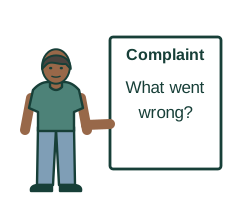
Complaining about discrimination can be a protected act.
This means an action protected by equality law.
Helping someone else’s equality complaint can also be protected.

Punishing someone for a protected act can be victimisation.
An honest complaint need not succeed to be protected.
Not every general complaint has this protection.
You need not be disabled to have this protection.
You might be supporting someone else’s disability complaint.
Ask an adviser about your situation.

Records, reporting and advice
Repeated unwanted contact may be criminal harassment or stalking.
A single threat or attack may also be a crime.
You do not need to wait before asking for help.
Keep useful messages and dates if safe.
Do not take risks to collect evidence.
You can report without a complete record.
Ask for help to explain the problem.
You can use a workplace or service complaints process.
Ask for communication support and a safe contact method.

Ask for advice promptly.
Court and tribunal claims have time limits.
An ordinary complaint does not automatically pause them.
Call 999 if someone is in immediate danger.
For other police reports, call 101 or report online.
EASS can explain equality rights and support options.
What you can do next
Call EASS on 0808 800 0082.
Ask for help in a format you understand.
Contact the Equality Advisory and Support Service Web pageThis link opens another website.
It may use harder words.
More useful links
- Equality Advisory and Support Service Web page
Equality information, accessible contact options and informal help; not legal representation.
- Acas: harassment at work Web page
Understand the workplace tests and complaint routes.
- Police: reporting stalking or harassment Web page
You do not need to collect a complete evidence file before reporting.
These links open other websites.
They may use harder words.
Harassment, bullying and being punished for speaking up
Understand unwanted behaviour, Equality Act protections and how to seek support or challenge retaliation.
Work and everyday services · England · Legal protection depends on the setting and circumstances
Start with safety and the support you want
Unwanted behaviour can happen at work, in a service, at home or online. It may include mocking someone’s communication, humiliating comments, threats or repeated unwanted contact. You are not responsible for another person’s harassment. You do not have to confront them or prove a legal case before asking for support. If someone is in immediate danger or a crime is happening, call 999. For other police concerns, use 101 or the police website.
What Equality Act harassment means
The Equality Act covers unwanted conduct connected with a relevant protected characteristic where its purpose or effect is to undermine dignity or create a threatening, hostile, degrading, humiliating or offensive environment. The legal assessment considers your perception, the circumstances and whether that effect is reasonable. A serious single incident can qualify; it does not have to be repeated. Bad intentions are not essential, and you do not have to have objected beforehand. The law can cover conduct you witness and a characteristic you are perceived to have or are associated with.
Which characteristics and settings are covered
The relevant harassment characteristics are age, disability, gender reassignment, race, religion or belief, sex and sexual orientation. But coverage differs between work, services, education and other settings. For services and public functions, the specific harassment provisions exclude religion or belief and sexual orientation; direct discrimination or other law may still apply. Marriage/civil partnership and pregnancy/maternity are not separate harassment characteristics, although pregnancy-related conduct may be sex harassment. Not every instance of bullying meets an Equality Act test. That does not make it acceptable or remove other possible protection.
Sexual harassment has its own protection
Unwanted behaviour of a sexual nature can be harassment when it has the required purpose or effect. Examples may include unwanted sexual comments, messages, images or touching. The law also protects against worse treatment because someone rejected or submitted to sexual harassment, or harassment connected with sex or gender reassignment. Going along with something because of pressure does not make you responsible for it. If a sexual offence may have occurred, you can seek police and specialist support as well as raising a workplace or service complaint.
What victimisation means
Victimisation means suffering a disadvantage because you did a protected act, or because someone believes you did or may do one. Protected acts include alleging Equality Act discrimination, bringing a claim or helping another person’s equality complaint with information or evidence. You do not need to have a protected characteristic yourself. For example, refusing someone a service because they complained about disability discrimination may be victimisation. The link to the protected act matters: a later disappointment alone does not prove retaliation.
A complaint need not succeed to be protected
You do not have to use the words Equality Act when raising an equality concern. The substance of what you said matters. A general complaint about poor service is not automatically a protected act. An honest allegation can remain protected even if it is not upheld. False allegations or evidence given in bad faith are excluded. Keep the original complaint and any later decisions, messages or reasons that may show a connection. Ask an adviser to assess what happened.
Criminal harassment and stalking are different
Protection from Harassment Act offences involve a course of conduct, ordinarily at least two incidents, plus other legal conditions. They do not require a protected characteristic. Stalking involves a pattern of unwanted, fixated or obsessive behaviour, such as following, monitoring or repeated contact. A single threat, assault or other incident may still be a different crime. Do not wait for another incident or gather a complete file before contacting police. Describe the behaviour and let them consider the appropriate offence.
Keep useful information without taking risks
If safe, record dates, places, what happened, its effect and any witnesses. Keep original messages, emails and relevant decisions. Screenshots can help, but retain dates and account details where possible. Separate what you directly saw or heard from what someone else told you or what you suspect. Lack of witnesses should not stop you reporting. Do not provoke contact, confront someone or put yourself at risk to obtain evidence. The private reporting worksheet in the hate-crime guide can help plan support without writing a detailed account.
Raise the issue through an accessible route
At work, speak to an appropriate manager, HR or your union, or use the formal grievance process. If the manager is involved, use another named contact. A serious matter can be raised formally without first confronting the person. For services, use the provider’s complaints route and explain the equality concern and change you need. Ask for Easy Read information, communication support, a chosen supporter and a safe contact method. Employment protection for volunteers or other unpaid roles may differ, so check the correct legal route.
Ask for protection and a clear response
Explain what would help now: stopping unwanted contact, a safe way to use the service, restoring access or addressing the behaviour. Ask who will investigate, what information will be shared, when you will hear back and how further retaliation will be handled. Do not accept a solution simply because it is called mediation; discuss whether it is appropriate and safe. Where there is abuse, neglect or exploitation, a safeguarding referral may also be needed. The person’s wishes and communication should remain central.
Get the right advice before deadlines pass
The Equality Advisory and Support Service, EASS, offers equality information and help with informal resolution: 0808 800 0082. It does not provide legal advice or court representation. Acas and a union can help with workplace routes; a solicitor or law centre can advise on legal claims. Work, service and criminal complaints have different rules. Internal complaints do not automatically stop court or tribunal time limits. Seek advice promptly, including while an investigation is ongoing. See the linked workplace and service-discrimination guides.
Words you could use
“I want to report unwanted behaviour and explain its effect on me. Please use an accessible process, tell me what protection is available and confirm who will respond and when.”
More useful links
- Equality Advisory and Support Service Web page
Equality information, accessible contact options and informal help; not legal representation.
- Acas: harassment at work Web page
Understand the workplace tests and complaint routes.
- Police: reporting stalking or harassment Web page
You do not need to collect a complete evidence file before reporting.
These links open other websites.
They may use harder words.
Where the information comes from
Links checked 1 November 2026.
These links open other websites.
They may use harder words.
- Equality Act 2010, section 26 Web page
Harassment, sexual conduct, rejection/submission and relevant characteristics.
- Equality Act 2010, section 27 Web page
Protected acts, disadvantage, belief and the bad-faith exception.
- Equality Act 2010, section 29 Web page
Services/public functions and the religion/belief and sexual-orientation harassment exceptions.
- EHRC: harassment and victimisation Web page
Unwanted conduct, association/perception and the need for a covered setting.
- EHRC 2026 Services Code: harassment Web page
Context, single incidents, sexual harassment and the purpose/effect assessment.
- EHRC 2026 Services Code: victimisation Web page
No need for the complainant to have a protected characteristic and the causal link.
- Acas: harassment at work Web page
Examples and distinctions from bullying and other laws.
- Acas: victimisation Web page
Good-faith complaints, evidence and treatment because of a protected act.
- Acas: responding to bullying Web page
Useful records, witnesses and routes when a manager is involved.
- Acas: raising a workplace problem Web page
Formal grievances may be appropriate without prior informal resolution.
- Acas: workplace discrimination complaints Web page
Prompt advice and strict claim time limits.
- Police.uk: stalking and harassment Web page
Repeated conduct, stalking patterns and single incidents that may be other offences.
- Police.uk: reporting harassment Web page
Reporting without waiting to gather evidence.
- EASS: contact and remit Web page
Verified number and limits of the service.
- Acas: tribunal time limits Web page
Ordinary workplace complaints do not pause the deadline; early conciliation has separate rules.