Planning & support · England
CTR and CETR: a review of your care
Your browser or device provides the reading voice.
CTR means Care and Treatment Review.
CETR means Care, Education and Treatment Review.
A CETR also looks at education.

Who the review is for
These reviews are for people with a learning disability.
They are also for autistic people.
You might be at risk of needing a mental health hospital.
Or you might already be in one.

The review looks at support you need.
This could help you stay at home.
It could help you leave hospital.

Ask and get ready
You can ask for a review.
Ask your care coordinator, keyworker or community team.
A family member or advocate can help you ask.

Someone should explain the review to you.
They should explain how your information will be used.
They will ask if you agree.
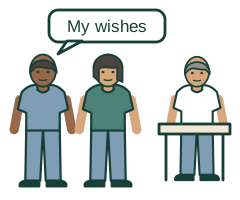
You can ask someone you trust to support you.
An advocate helps you speak up.
Ask how to get an advocate.

Tell people what matters to you.
You can use words, pictures or a communication aid.
You can ask for a break.

Talk about your health and your daily life.
Talk about learning, friends and things you enjoy.
Say what you want to change.

What happens next
Ask for a copy of the plan.
It should say who will do each job.
It should say when each job will be done.

Ask what has happened since the review.
Tell someone if the plan is not working.
Do not wait for a review if you are unsafe or need urgent help.
What you can do next
I want someone to look at my care and support.
Please explain whether I can have a CTR or CETR.
Please help me share what matters to me.
Read the NHS guide to reviews Web pagePlain EnglishThis link opens another website.
It may use harder words.
More useful links
- NHS Easy Read guide: a review in the community Web pageEasy ReadOfficial guidance
Use the questions to think about what you want to tell the panel.
- NHS Easy Read guide: children and young people in hospital Web pageEasy ReadOfficial guidance
Explains taking part and questions about education, care, health and future plans.
- NHS C(E)TR policy and toolkit Web pageOfficial guidance
Preparation checklists, guidance and other review resources.
These links open other websites.
They may use harder words.
Care, Education and Treatment Reviews (CETRs) and Care and Treatment Reviews (CTRs)
Asking for a review, getting ready, having your say and checking that agreed support happens.
Children, young people and adults with a learning disability or autistic people · England
What are these reviews?
A Care and Treatment Review (CTR) brings an independent perspective to care and support. A Care, Education and Treatment Review (CETR) includes education. C(E)TR is the combined name. They explore support that could prevent an unnecessary mental health admission, improve hospital care or help someone leave hospital. They are different from an annual health check, an EHCP annual review and a Community Treatment Order (CTO). A CETR does not replace the statutory EHCP assessment, annual review or appeal process.
Who can have one?
These reviews are for people with a learning disability, autistic people, or both, where mental health hospital admission is a risk or has happened. The children's and young people's CETR pathway can continue up to 25 where an EHCP is in place, or after 18 while someone remains in a children's and young people's mental health inpatient service. Ask which pathway applies; turning 18 should not make education needs disappear.
How to ask
You, a family member, advocate or professional can request a review. Ask your care coordinator, community team, keyworker or the ICB learning disability and autism team to contact the responsible commissioner: the organisation arranging and paying for the relevant NHS care. Explain what is missing, why admission is a risk, or what is preventing discharge. Ask about the Dynamic Support Register too. A request does not automatically mean a review will be arranged: needs and the current situation must be considered.
Your agreement and involvement
The process and information sharing should be explained in a way you understand. Your consent is sought for each review. Where you cannot make this particular decision, the appropriate legal process must be followed, including a best interests decision where applicable. A learning disability does not itself mean you cannot decide. You can choose a trusted supporter and ask about independent advocacy. Saying no should not remove care or resources you are otherwise entitled to. A parent does not automatically have authority to consent for an adult child.
Who is involved?
The panel includes a commissioner chair, an independent clinical expert and an independent expert by experience. The latter brings personal or family experience of relevant services. Relevant health, social care and education staff take part alongside you and the people you want involved. Ask who is attending, why they are needed and how your communication will be supported. Independence does not mean the whole panel is separate from the organisation funding care: the commissioner chairs it.
Preparing in your own way
List what is going well, what worries you and what you want to change. Bring a communication passport, relevant care plans and previous review actions. Choose a supporter. Ask for Easy Read information, questions in advance, a quiet space, breaks, communication aids or an interpreter. You can share pictures, write, use video or ask someone to explain your views. You do not have to speak throughout a large meeting. Think about home, relationships, learning, work, hobbies and your hopes.
Questions worth raising
Discuss safety, physical and mental health, medication, restrictions, meaningful activity, education and quality of life. Ask what support could work at home. If hospital is proposed or continues, ask what assessment or treatment needs hospital, what its intended benefit is, and what needs to happen before discharge. Mention pain, constipation, eating or swallowing difficulties, sleep, sensory distress and communication needs where relevant. Ask whether distress is being understood and whether restrictions can be reduced.
When should reviews happen?
Under NHS England's 2023 policy, a community review should normally precede admission. If none occurred, the post-admission timescale is 28 days for adults and 14 days on the children and young people's pathway. After a community review, a further review should occur within six weeks of admission if the person remains in hospital. Repeat reviews are at least every six months for adults in non-secure services, twelve months in secure services and three months on the children and young people's pathway. Earlier reviews can be requested. Transfers, changes in security level, a new diagnosis of learning disability or autism, or a proposal to remove either diagnosis can trigger additional reviews.
After the review
Ask for the report in a format you understand: NHS guidance says it should be sent within two weeks. Each action needs a named person and a completion date. Ask who will keep you updated. The commissioner is responsible for following up recommendations; actions should inform the DSR and relevant care or education plans. Keep an action tracker and ask why anything remains undone. A review's recommendations do not themselves discharge someone or replace clinical, tribunal or court decisions.
If the review is refused or actions are not happening
Ask for the reasons, the local review-request escalation route and the name of the responsible commissioner. A request for a review should not itself be treated as a complaint. Concerns about how a review was conducted can use the NHS complaints process. An advocate can help you describe the problem, request a response and escalate it. Raise immediate safety or safeguarding concerns without waiting for the next review. A review must not delay urgently needed treatment or an otherwise appropriate discharge.
Policy and changes to the law
This guide describes NHS England's published review policy. The Mental Health Act 2025 contains further changes, including statutory review arrangements, but implementation is phased. Do not assume every new provision applies just because the Act has received Royal Assent.
Words you could use
“Please consider my request for a CTR or CETR. I am concerned about my support and want to explain what matters to me. Please tell me who will arrange it, how I can take part and what happens next.”
More useful links
- NHS Easy Read guide: a review in the community Web pageEasy ReadOfficial guidance
Use the questions to think about what you want to tell the panel.
- NHS Easy Read guide: children and young people in hospital Web pageEasy ReadOfficial guidance
Explains taking part and questions about education, care, health and future plans.
- NHS C(E)TR policy and toolkit Web pageOfficial guidance
Preparation checklists, guidance and other review resources.
These links open other websites.
They may use harder words.
Where the information comes from
Links checked 2 November 2026.
These links open other websites.
They may use harder words.
- NHS England: DSR and C(E)TR policy and guidance PDF
National policy implemented from May 2023; see sections 2, 13 and 20 for scope, consent, review timescales and escalation.
- NHS England: plain English explanation Web pagePlain English
Accessible explanation of the review, its purpose, participants, consent and requesting a review.
- NHS England: C(E)TR code of practice Web page
Panel independence, participation, action plans and commissioner follow-up responsibilities.
- NHS England: About me — adults in the community Web page
Questions to prepare for, ways of taking part and the report after the review.
- NHS England: My Care and Treatment Review Web page
Preparation and participation booklets with and without symbols.
- DHSC: discharge from mental health inpatient settings Web page
Discharge planning and escalation of unresolved concerns.
- Mental Health Act 2025: commencement Web page
The Act provides for phased commencement; enactment and implementation are different.
- Parliament: implementation of the Mental Health Act 2025 Web page
Ministerial answer of 14 September 2026 confirms a phased approach to commencement and a revised Code of Practice.
- NHS England information reuse and attribution Web page
Contains public sector information licensed under the Open Government Licence v3.0. Original explanations draw on NHS England policy and accessible guidance.
A page for you to fill in
You can type your answers and download a copy.
You can also print a page to write or draw on.
Someone you trust can help you.