Advocacy · England
Help with your mental health rights
Your browser or device provides the reading voice.
An independent mental health advocate is often called an IMHA.
An IMHA helps you understand your rights and explain your wishes.

The Mental Health Act is a law about mental health care.
It allows services to keep some people in hospital for treatment.
There are rules about when services can do this.
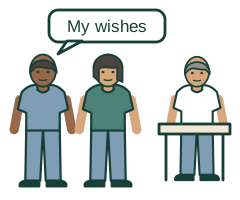
Many people kept in hospital under this law have a right to an IMHA.
There are exceptions.
Ask staff to check the rules that apply to you.

Some people living outside hospital also have this right.
For example, this can apply under a community treatment order.
A community treatment order sets rules for treatment outside hospital.

Some people have this right because of a particular treatment being considered.
Ask your care team to check.

The IMHA can explain your rights and treatment choices.
They can help you prepare for meetings.
They can help you question decisions.

You can get an IMHA even if you can make your own decisions.
You can ask to speak with the advocate in private.
This support is free.
Being in hospital by choice does not always give you this right.
Ask about other advocacy support if you cannot get an IMHA.

An IMHA is different from a solicitor.
A solicitor gives legal advice.
Ask for legal advice if you want to challenge a legal decision.
What you can do next
Ask ward staff or your person who organises your care about an IMHA.
Tell them what help you need to communicate.
Read the NHS Easy Read IMHA leaflet PDFEasy ReadThis link opens another website.
It may use harder words.
Independent mental health advocacy — IMHA
Understanding and using your rights under the Mental Health Act.
People who qualify under the Mental Health Act · England
Who usually qualifies
The main groups are people liable to be detained under the Mental Health Act, people under guardianship and people on a community treatment order. This can include someone on leave from detention. There are also specific rights for certain proposed treatments.
Exceptions and treatment-specific rights
The main detention route excludes sections 4, 5, 135 and 136. Separate rights cover people discussing treatment under section 57 and people under 18 discussing treatment under section 58A, which includes ECT. Ask the service to check your actual legal status.
How an IMHA can help
They can explain the relevant parts of the Act, conditions, treatment safeguards and rights to challenge decisions. They can help you prepare for meetings and express your wishes. An IMHA is not automatically your solicitor or tribunal representative.
You do not have to lack capacity
IMHA eligibility is not based on being unable to decide for yourself. You can ask to meet the advocate privately. Tell the service what communication support you need.
If you are in hospital voluntarily
Do not assume the same legal entitlement applies to every voluntary patient. Ask about the treatment-specific rules and any local non-statutory advocacy. The Mental Health Act 2025 introduced reforms with phased commencement; this guide does not treat every reform as already in force.
Words you could use
“Please explain whether I qualify for an independent mental health advocate and help me contact the service.”
Where the information comes from
Links checked 26 October 2026.
These links open other websites.
They may use harder words.
- Mental Health Act 1983, section 130C Web page
Current qualifying-patient rules for England.
- Mental Health Act 1983, section 130B Web page
The help an IMHA can provide.
- Mental Health Act Code of Practice Web page
Chapter 6 explains advocacy under the Act.
- Mental Health Act 2025, section 56 Web page
Reforms commence in stages; Royal Assent alone does not activate every change.
- First commencement regulations, 2026 Web page
These regulations commence sections 51 and 52 of the 2025 Act.