Everyday life · England
Assistance dogs and companion dogs
Your browser or device provides the reading voice.
Different dogs help people in different ways.
This guide is about support and services in England.

A dog that helps you
An assistance dog helps a disabled person.
A guide dog helps someone with sight loss.
Other dogs help in different ways.
A companion dog
A companion dog gives company and comfort.
This does not mean it can go into every place.
You can explain your needs and ask about access.

Finding out what would help
Ask a suitable dog organisation for advice.
They will look at your needs and the dog’s needs.
There may be a waiting list.

Learning to work together
You and your dog may need training and support.
Ask for information in a way you understand.
A dog will not be right for everyone.

Caring for your dog
Your dog needs food, water, exercise and rest.
It needs the right care and help from a vet.
Agree who will help with these things.

A backup plan
Plan who will care for your dog if you are unwell.
Check that the person has agreed to help.
Ask what help your support service can provide.

Let a working dog concentrate
People should talk to you first.
They should not distract your dog when it is working.
They should check with you before touching or feeding it.

Going to places
An assistance dog can usually go with you into shops and services.
A no-pets rule should not simply stop you.
Ask for help if you are refused.

Dog identification
There is no official UK register of assistance dogs.
An assistance dog does not have to wear a special jacket.
You do not have to carry an assistance-dog ID card to use services.
Other people’s needs
Some people are allergic to dogs.
Staff should look for ways to meet both people’s needs.
They should not simply ban every assistance dog.

If someone says no
Ask the manager to explain the reason.
Ask what could make the visit possible.
Keep a note of what happened.
Help to speak up
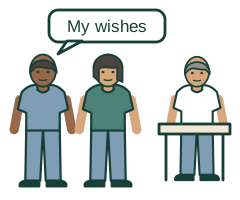
You can ask an advocate or adviser for help.
Our pet guide helps you plan care, costs and support.
What you can do next
This link is longer information.
You can ask someone to help you read it.
Read about assistance dogs and access Web pageThis link opens another website.
It may use harder words.
More useful links
- Assistance Dogs UK: training an assistance dog Web pageLonger information
Training options and links to organisations that can assess applications.
- Guide Dogs: is a guide dog right for me? Web pageLonger information
Individual assessment, eligibility and the needs of a guide-dog partnership.
- EHRC: assistance dogs and services Web pageLonger information
Access, reasonable adjustments and individual circumstances.
These links open other websites.
They may use harder words.
Assistance dogs, guide dogs and companion dogs
Understand different kinds of dog support, getting help, caring for a dog and asking for access to services.
Adults aged 18 and over · England
Different dogs give different support
A guide dog helps someone with sight loss. Other assistance dogs may help with hearing, movement, medical conditions or mental health needs. The help depends on the person and the dog. A companion dog provides company and comfort. A visiting therapy dog usually works with a handler to support other people. These descriptions do not all mean the same thing.
Companion and emotional support dogs
A dog can matter greatly to you without being an assistance dog. Calling a dog an emotional support animal does not automatically give it access to every service. The Equality Act does not define emotional support animals. Depending on the facts, allowing a disabled person’s dog may still be a reasonable adjustment. Ask for individual consideration. Housing and transport have separate rules.
Training, jackets and identification
Most assistance dogs are highly trained. Training may be provided by a charity, an independent trainer or the owner. There is no compulsory UK assistance-dog register, ID card or jacket. Charity membership is not a legal requirement. For services, EHRC guidance says training is not itself a legal prerequisite. An online certificate does not create access rights. Ask for advice before paying anyone who promises registration.
Finding suitable help
Start with the support you need, then contact a relevant assistance-dog organisation. Assistance Dogs UK lists organisations but does not itself supply dogs. Each organisation assesses suitability and may have eligibility rules or a waiting list. Guide Dogs assesses sight loss, mobility and the ability to work with and care for a dog. Ask what communication support or training adjustments are available. A dog will not suit everyone; discuss other options too.
Plan care and respect the partnership
Agree feeding, fresh water, exercise, rest, grooming, toileting and veterinary care. Plan backup help if you or your usual supporter are unwell. Ask which help the dog organisation provides and what help your support service can agree; do not assume animal care is included in funded support. Staff and visitors should speak to you, follow your instructions and avoid distracting a working dog. They should not touch or feed it without checking with you.
Going to shops and other services
Services must consider reasonable adjustments for disabled people. A general no-dogs policy should not simply be applied to an assistance-dog user. You should not be refused just because you lack an ID book. Explain what support your dog provides and any arrangements you need. Access rights are strong but not unlimited; an unusual setting or an actual safety issue needs individual consideration. Check separate arrangements for housing, travel and overseas journeys.
Other people’s needs
A possible allergy or a staff member’s religious or cultural belief is not a general reason to exclude assistance-dog users from services. If someone has an actual allergy, plan ways to reduce contact and meet both people’s needs. Discuss specific concerns respectfully. A blanket ban will rarely be the right response.
If access or support is refused
Ask the manager for the reason and a practical solution. Keep a note of the place, date, what happened and any reply. Ask for the complaints process and advice from the Equality Advisory and Support Service or another discrimination adviser. An advocate can help you explain the problem. For help caring for your dog, ask for a review of your support plan. Our pet guide covers costs, housing permission and backup care.
Words you could use
“My dog helps me. Please ask what help my dog gives me and discuss the support and access we need.”
More useful links
- Assistance Dogs UK: training an assistance dog Web pageLonger information
Training options and links to organisations that can assess applications.
- Guide Dogs: is a guide dog right for me? Web pageLonger information
Individual assessment, eligibility and the needs of a guide-dog partnership.
- EHRC: assistance dogs and services Web pageLonger information
Access, reasonable adjustments and individual circumstances.
These links open other websites.
They may use harder words.
Where the information comes from
Links checked 5 November 2026.
These links open other websites.
They may use harder words.
- EHRC: assistance dogs, businesses and service providers Web pageLonger information
Service access, emotional support animals, training, allergies and cultural or religious objections. This guidance does not cover the separate transport or housing provisions.
- Assistance Dogs UK: registration and proof Web pageLonger information
No official UK registration or compulsory identification system.
- Assistance Dogs UK: training an assistance dog Web pageLonger information
Owner, independent-trainer and charity routes; ADUK does not itself provide dogs.
- Guide Dogs: is a guide dog right for me? Web pageLonger information
Individual suitability, assessment and dog welfare.
- UK Parliament: assistance dogs and access Web pageLonger information
Government explanation of reasonable adjustments and the absence of a documentation requirement for service access.
- Guide Dogs: avoiding distractions Web pageLonger information
Why touching, talking to or feeding a working guide dog can endanger its handler.
- RSPCA: the five welfare needs Web pageLonger information
Food, water, shelter, health, normal behaviour and suitable company.