Carers & future planning · England
You can be a carer and need help too
Your browser or device provides the reading voice.
This guide is about unpaid caring in England.
People with learning disabilities can care for other people.
Your caring role matters
You might help a parent, partner, friend or sibling.
You might also need support yourself.

Your help and your own needs both matter.
People should not assume you cannot care.
Ask for assessments
Ask the council for a carer’s assessment.
This looks at caring and the support you need.

The assessment is free.
You do not need to receive Carer’s Allowance.
Some services may have a charge.

Ask about your own care needs too.
You can need more than one kind of assessment.

Explain the help you need
Ask for questions you understand and time to answer.
You can use pictures or your communication aid.
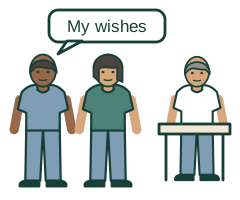
You can ask someone to help you speak up.
Ask the council whether you qualify for an independent advocate.

Explain what you do during the day and night.
Say how caring affects your health and free time.

Say what caring you want and feel able to do.
You can ask for breaks, training or more help.
Benefits and backup support
Carers under 18 can ask children’s services for support.
Parents of disabled children can ask about parent carer assessments.
Get a benefits check before claiming carer benefits.
A claim can affect someone else’s benefits.

Make a plan for when you cannot provide care.
Ask for a review if things change.

Tell someone if you feel pressured or unsafe.
Call 999 if someone is in immediate danger.
What you can do next
Explain your caring role and your learning disability.
Ask for information and meetings you can understand.
Find your council Web pageFuller informationThis link opens another website.
It may use harder words.
More useful links
- NHS: prepare for a carer’s assessment Web page
Explain what you do and the effect on your life.
- NHS: young carers’ rights Web page
Information for carers under 18 and their families.
These links open other websites.
They may use harder words.
When you have a learning disability and care for someone
Get support for your caring role and your own needs while keeping the relationships that matter to you.
Unpaid carers with learning disabilities and their supporters · England
Recognise the care you already give
You may help a parent, partner, friend, sibling or another person with shopping, meals, appointments, reassurance or staying safe. You may share caring with someone who also supports you. Having a learning disability does not mean you cannot care or that your contribution is unimportant. You do not have to use the word carer about yourself to explain that you need help. This guide is mainly about unpaid care, not a paid care job.
Ask for a carer’s assessment
If you are 18 or over and provide or intend to provide care for another adult, ask the council’s adult social care team. The council must assess where it appears you may need support now or in the future. This does not depend on your savings, receiving Carer’s Allowance or caring for 35 hours a week. You do not have to live with or be related to the person. The assessment is free; eligibility and any charge for services are considered separately.
Ask about your own care needs too
You may need help with communication, personal care, getting out, managing your home or your health. Ask for your own needs assessment or review as well as a carer’s assessment. The person you support may need their own assessment. These should recognise how your lives connect without treating either person’s unpaid help as unlimited. Assessments can be coordinated, with consent where required, while keeping each person’s wishes and confidential information clear.
Make the assessment accessible
Ask for Easy Read questions beforehand, a suitable place, extra time, breaks or your communication aid. You can ask a chosen person to help and request time to speak privately. Explain if that supporter is also the person you care for and you need independent help. The council must arrange Care Act advocacy where you have substantial difficulty taking part and there is no appropriate person to support you; it is not automatic for every carer.
Show what caring involves across a week
Use a diary, pictures or the worksheet to record tasks, night-time interruptions, emotional support and appointments. Include help you give while tired or unwell and tasks others do not see. Describe effects on your sleep, physical and mental health, learning, paid work, friendships and time alone. Say what you enjoy about caring as well as what is becoming difficult. You do not need to wait until a crisis.
Agree support that protects the relationship
Possible plans include breaks, support for the person you care for, accessible training, practical help, transport or a local carers group. Ask for instructions you can use and help with unfamiliar tasks. Do not carry out lifting, medicines or other care tasks beyond what you can safely do with the training and support provided. It can help to plan time together as family or friends, rather than every meeting being about care.
Be clear about willing and able
The assessment must look at whether you are willing and able to continue caring. You can want to help while needing fewer tasks or more support. Caring should not be forced by threats, guilt or the absence of a suitable care package. Tell social care promptly if a task or situation is unsafe. Having difficulty with some tasks is a reason to plan support, not proof that your relationship should end.
Use the right route for children and young carers
If you are under 18 and care for someone, ask children’s services for a young carer’s assessment; a teacher or trusted adult can help. It should consider your wishes, education, health and whether the caring role is appropriate. If you are an adult with parental responsibility for your disabled child, ask the council’s children with disabilities team about a parent carer needs assessment. Ordinary parenting, a child’s additional needs and caring for another adult may require different support routes.
Check money and employment separately
Ask for a benefits check before claiming a carer benefit: there are conditions and possible effects on the cared-for person’s benefits. A carer’s assessment is not a Carer’s Allowance claim. You can receive disability benefits and have a caring role; entitlement depends on the relevant rules. If you work, use the working-while-caring guide to ask about leave, flexibility and support. Tell advisers about your own disability-related needs too.
Plan backup and ask for help when things change
Agree who will help if you are ill, in hospital or unavailable, and make the contact route easy to use. Ask for a review when caring or your own needs change. For immediate danger call 999. If abuse, neglect or pressure is affecting either of you, contact the council’s safeguarding team and use the safeguarding guide. Where a child may be unsafe, contact children’s services; do not assume disability alone means a child is at risk.
Words you could use
“I have a learning disability and provide unpaid care. Please arrange an accessible carer’s assessment and consider my own care needs too.”
More useful links
- NHS: prepare for a carer’s assessment Web page
Explain what you do and the effect on your life.
- NHS: young carers’ rights Web page
Information for carers under 18 and their families.
These links open other websites.
They may use harder words.
Where the information comes from
Links checked 1 November 2026.
These links open other websites.
They may use harder words.
- Care Act 2014, section 10 Web page
Adult carer assessment duty, willingness, ability and involvement.
- NHS: carer’s assessments Web page
Practical routes, preparation, support and separate financial assessment.
- Care Act 2014, section 67 Web page
Independent advocacy during assessments where the legal conditions apply.
- Care and support statutory guidance Web pageFuller information
Whole-family planning, accessible assessments and sustainable care.
- NHS: young carers’ rights Web page
Children’s assessment, wishes, education and appropriate caring roles.
- NHS: care needs assessments Web page
Assessment for the carer’s own care and support needs.
- Children Act 1989, section 17ZD Web page
Parent carer needs assessments and parental responsibility.
- GOV.UK: Carer’s Allowance and other benefits Web page
A claim can affect the carer’s and the cared-for person’s benefits.
A page for you to fill in
You can type your answers and download a copy.
You can also print a page to write or draw on.
Someone you trust can help you.